Many buyers assume Dubai is a cash only market. It is not. Local banks lend to residents and non residents alike, and a mortgage remains the simplest way to lift the return on equity of an asset that was bought well in the first place.
The framework, however, differs sharply from Europe. Down payments are higher, terms shorter, acquisition fees are paid in cash, and underwriting looks harder at the asset and your gross income than at a finely tuned debt ratio.
This guide sets out the rules that apply in 2026, the numbers to budget for, and one important change: the off plan finance product launched by Dubai Islamic Bank, funding up to 50 % and open to non residents.
Who can borrow in Dubai
Three profiles coexist. UAE residents, with a visa and local salary or business income, get the best terms. Non residents, employed or self employed abroad, face a narrower but very real market served by around ten banks. Buying through a company, usually a local or approved offshore structure, is possible with a heavier file.
From the bank's side, the file comes down to three things: the stability of your income, your banking history, and the quality of the asset. A recognised developer in a liquid freehold area moves a file far faster than a confidential project.
- Maximum age at maturity: often 65 for employees, 70 for self employed borrowers.
- Minimum income frequently asked of non residents: the equivalent of AED 15,000 to 25,000 per month.
- Usual term: 15 to 25 years for residents, 15 to 20 years for non residents.
Down payment and LTV caps
The Central Bank of the UAE caps loan to value ratios. The benchmarks below are the regulatory ceilings; each bank then applies its own risk policy, usually more conservative for non residents.
The key point: the equity you need is higher than in Europe, and it comes on top of acquisition fees. On a AED 2 million property financed at 60 %, you need roughly AED 800,000 of equity plus AED 120,000 of fees.
| Profile and property | Indicative maximum financing | Minimum down payment |
|---|---|---|
| Resident, first completed home under AED 5M | 80 % | 20 % |
| Resident, first completed home above AED 5M | 70 % | 30 % |
| Resident, subsequent property | 60 to 65 % | 35 to 40 % |
| Non resident, completed property | 50 to 60 % | 40 to 50 % |
| Off plan, standard framework | 50 % | 50 % |
New in 2026: DIB off plan finance up to 50 %
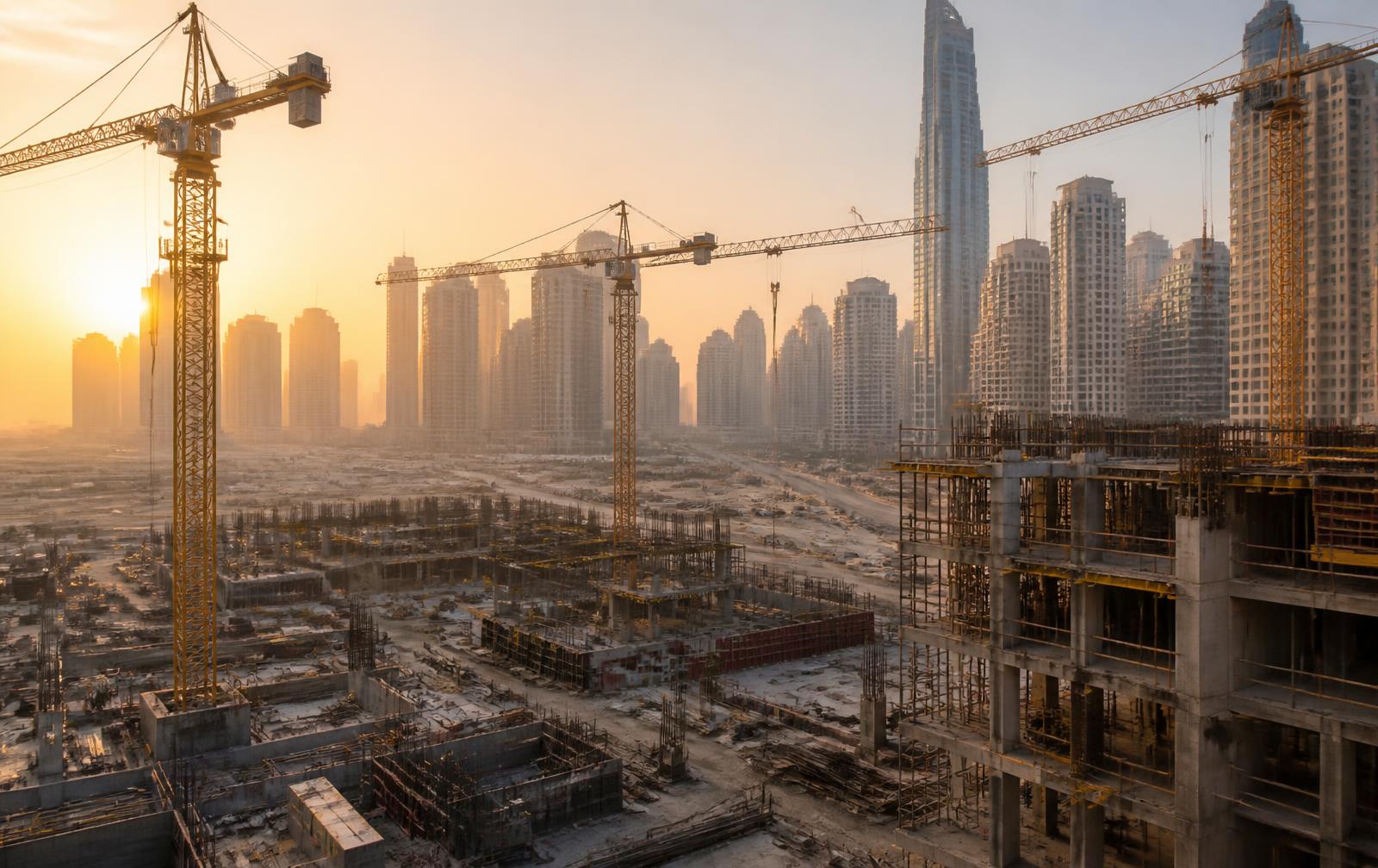
Until now, off plan was poorly served: most banks waited for handover, leaving the buyer to face the developer's payment plan alone. In August 2026, Dubai Islamic Bank launched a dedicated product, Off Plan Home Finance, which changes the picture for buyers under construction.
The principle: the bank funds up to 50 % of the value of a freehold property under construction from leading developers, and releases funds in line with the developer's construction milestones. During the build, the buyer pays only the profit portion, which rises progressively as tranches are disbursed.
The full instalment, principal and profit, starts at handover or 24 months after the finance is taken, whichever comes first. That clause deserves a project by project check: on a three year build, you will be paying the full instalment before you get the keys.
The product is Shariah compliant, available across all emirates, and open to UAE nationals, residents and non residents subject to eligibility. DIB has also said it is working on direct arrangements with major developers to streamline the process.
- Up to 50 % finance to value on off plan, freehold properties only.
- Disbursement aligned with the developer's construction milestones.
- Only the profit portion is paid during construction.
- Full instalment at handover or at 24 months, whichever comes first.
- Open to non residents, subject to eligibility.
Rates, margins and the real cost
Two families coexist. Fixed rates, reassuring, over an initial 1 to 5 year period, then reverting to a variable rate. Variable rates are indexed to EIBOR plus a bank margin and track US monetary policy, since the dirham is pegged to the dollar.
In 2026, observed pricing broadly runs from 3.9 to 5.5 %. A salaried resident at a large bank sits at the bottom of the range. A self employed non resident with a more complex file sits at the top.
The right reflex is not to compare headline rates but total cost: the margin after the fixed period, arrangement fees, insurance, and above all early settlement penalties if your strategy involves a quick resale.
| Item | 2026 benchmark | What to watch |
|---|---|---|
| 3 year fixed rate | about 3.9 to 4.6 % | Check the reversion rate after the fixed period |
| Variable rate | EIBOR + 1.25 to 2.25 % | Sensitive to Fed decisions |
| Bank arrangement fee | 0.5 to 1 % of the loan | Negotiable on larger files |
| Property valuation | AED 2,500 to 3,500 | Paid by the buyer |
| Early settlement | capped at 1 % or AED 10,000 | Decisive if you resell within 3 years |
Conventional loan or Islamic finance
UAE banks offer both. A conventional mortgage works as in Europe, with interest. Islamic finance uses other structures: Ijara, a lease with transfer of ownership at term, or Murabaha, a purchase and resale at a pre agreed margin.
For an investor the practical difference is limited: the monthly payment is comparable, the bank takes security over the property, and total cost is compared the same way. Islamic finance mainly imposes transparency on the margin and rules out some conventional late payment penalties.
DIB's off plan product sits in that framework: no interest accrues during the build, only a profit portion calculated on the tranches already released.
Fees to budget on top of the down payment
This is the line European buyers most often underestimate. In Dubai, acquisition costs are not rolled into the loan: they are paid in cash at signing.
| Item | Indicative amount | Basis |
|---|---|---|
| DLD transfer fee | 4 % | Of the purchase price |
| DLD registration fee | AED 2,000 to 4,000 | Flat, depending on price |
| Agency commission | 2 % | Of the purchase price |
| Mortgage registration | 0.25 % | Of the financed amount |
| Bank arrangement fee | 0.5 to 1 % | Of the financed amount |
| Life and property insurance | 0.4 to 0.8 % per year | Of the outstanding balance |
Borrow in Dubai or at home?
European banks rarely finance a property located in the UAE. Two routes stay open: a mortgage secured on a property you already own at home, or a Lombard loan secured on a securities portfolio. Rates are often lower, but you pledge another asset as collateral.
Local borrowing has one major advantage: the debt is denominated in dirhams, like your rent. You remove the currency mismatch between the debt and the income that services it. Over a ten year horizon, that matters more than half a point of rate.
- Debt in dirhams and rent in dirhams: no currency mismatch.
- Local financing also acts as external validation of the deal by a local bank.
- A Lombard loan still makes sense for a fast cash purchase, refinanced later.
The file and the timeline
Pre approval should be arranged before you make any offer. It is usually valid for 60 days and positions you far better with the seller, especially on a resale of position or a deal under pressure.
Allow three to six weeks between submission and disbursement, provided the documents are complete from the start.
- Passport, visa where applicable, proof of address.
- Six months of bank statements, personal and business.
- Three recent payslips, or two years of accounts if self employed.
- Latest tax return and a credit report from your country of residence.
- Reservation form or sale agreement, plus the bank's valuation of the property.
Five costly mistakes
Financing never rescues a bad entry price. It amplifies the outcome, in both directions.
- Signing a reservation before holding written pre approval.
- Failing to set aside the 6 % of fees in cash, on top of the down payment.
- Comparing headline rates without checking the margin applied after the fixed period.
- Ignoring the early settlement clause when the strategy targets a resale within three years.
- On off plan, not checking when the full instalment starts relative to the real handover date.
Sources
The figures in this guide are cross checked against the publications below. Check for updates before any decision.
- New off plan home finance offers up to 50 % funding for residents and non residents · Arabian Business · accessed 29 August 2026
- DIB launches Shariah compliant off plan home finance solutions · Zawya (DIB press release) · accessed 29 August 2026
- Consumer protection and mortgage lending regulation · Central Bank of the UAE · accessed 29 August 2026
- Transfer and registration fees on property transactions · Dubai Land Department · accessed 29 August 2026
- EIBOR reference rates · Central Bank of the UAE · accessed 29 August 2026
Frequently asked questions
Can a non resident get a mortgage in Dubai?
Yes. Around ten local banks lend to non residents, generally at 50 to 60 % of the price over 15 to 20 years, with a minimum monthly income equivalent to AED 15,000. The file requires more documentation than a resident application, but it is entirely accessible.
How much down payment do you need to buy in Dubai with a mortgage?
Around 20 % for a resident buying a first completed home under AED 5 million, and 40 to 50 % for a non resident. On top of that, budget roughly 6 % of acquisition fees, DLD and agency, which banks never finance.
Can you get a mortgage on an off plan property in Dubai?
Yes, since 2026, through Dubai Islamic Bank's Off Plan Home Finance, which covers up to 50 % of the value of a freehold property under construction. Only the profit portion is paid during the build; the full instalment starts at handover or after 24 months, whichever comes first.
What are Dubai mortgage rates in 2026?
Observed pricing runs from about 3.9 % for a salaried resident on a short fixed rate to 5.5 % for a self employed non resident file. Variable rates are indexed to EIBOR with a bank margin of 1.25 to 2.25 points.
Is it better to borrow in Europe or in the UAE?
A home country mortgage or Lombard loan can be cheaper, but it pledges another asset and creates a currency mismatch between euro debt and dirham rent. Borrowing locally removes that risk, which weighs more than half a point of rate over ten years.
Got a specific project in mind?
Guides set the framework. What follows depends on your objective, your horizon and the right asset at the right price.
See the opportunities